
The Lancet Misunderstands Markets
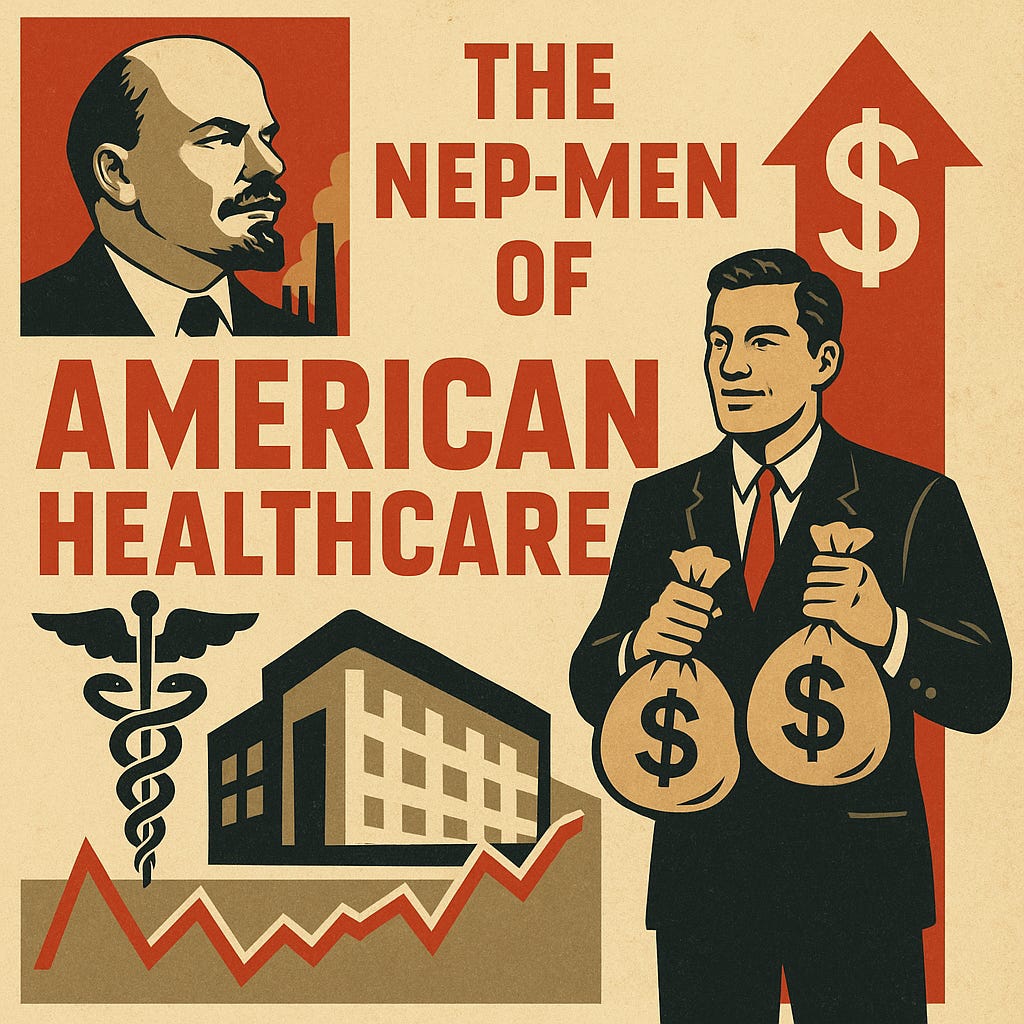
Central planners come after modern day NEP-men.

After subjugating Russia under force of arms, Bolshivek War Communism had left the economy in shambles. Quickly realizing the failures of full central planning fetishized by Marxist purists, Lenin introduced the New Economic Policy (NEP). Small businesses were once again allowed to buy and sell goods, but only under a state system that still controlled heavy industry, banking, and trade policy.
It was a permissioned pseudo-market. The regime fixed prices and quotas, requisitioned food, and allowed only limited free trade at the margins. Some NEP-men became wealthy, not through innovation or risk-taking, but by arbitraging the state’s own rules.
Sound familiar to US healthcare?
Once the NEP-men became visibly prosperous, the Soviet state blamed them for the chaos it had itself created. Party bosses scapegoated the wealthy merchants, who had only been following the state-established rules, as thieves and oppressors. Stalin eventually liquidated them in the name of ideological purity.
Now, a century later, America’s health-care planners are doing the same.
In a laughably earnest Lancet article, our modern socialists blame “markets” for the failures of U.S. health care, when every single example they cite is a product of central planning.
They’re blaming the NEP-men for outcomes caused by The Party.
The authors denounce “decades of market-based policies,” yet neglect to mention that Medicare and Medicaid are the opposite of markets, centrally priced, centrally defined entitlement programs with rules so complex they require an army of bureaucrats to interpret them.
There hasn’t been a “market based” healthcare system in the US since the 1950s.
Private insurers aren’t “free-market actors”; they’re federal contractors, largely paid by CMS through centrally planned, risk-adjusted formulae. When the authors complain about Medicare Advantage overpayments, what they’re describing is corporate entities naturally responding to the incentives that CMS created for them.
Every single example of “greed” the authors cite originates in centrally planned price controls or subsidies.
Dialysis and hospice exploded because Medicare guaranteed fixed payments.
Private equity rushed in because CMS created risk-free revenue streams without competition.
Consolidation flourishes because the regulatory maze makes independent practice impossible.
Even the Medicare fraud examples prove the point that there’s only one buyer worth defrauding: the government. In a functioning market, if you cheat your customer, your customer leaves. In a command economy, they just rewrite the rules.
Their villain, “profit,” is a tired cliché. Everyone in health care - doctors, nurses, hospital CEOs, billing clerks - works for compensation. Self interest isn’t a disease; it’s the baseline human condition.
The pathology lies in the distorted incentive structure where CMS dictates prices. In a market, prices convey information about the preferences of buyers and the resources of sellers. This directs resources to their most efficient use. People profit when they efficiently bring products to consumers at prices they are willing to pay.
In our system, “prices” are Soviet-style quotas disguised as billing codes.
When the authors lament rising administrative costs, they never admit that those costs exist to navigate government rules, not market competition. Any physician who has opted out of Medicare can tell you: administrative costs drop by 90%.
Like the Bolsheviks before them, the authors confuse crony corporatism with capitalism.
Large consolidated insurers and hosptial systems didn’t grow because of competition. They grew because CMS and state Medicaid agencies outsource care through managed-care contracts. They grew because regulation rewards scale and only a giant can survive the compliance burden. They grew because Certificate-of-Need laws, Stark restrictions, community rating, and 340B carve-outs all entrench incumbents.
Predictably, the Lancet authors conclude that “de-commercialisation” is the answer. But you can’t abolish self-interest by decree. A single-payer system would only double down on the disease, creating a single, state-run monopsony that sets prices, picks winners, and drives further consolidation.
As Hayek warned:
“Economic control is not merely control of a sector of human life… it is control of the means for all our ends.”
They’ve been controlling the system for over sixty years. Now they want more of it.
This paper could just as easily have been titled “How Central Planning Turned Health Care into a Rent-Seeking Machine.” Every example, from Tenet’s kickbacks to UnitedHealth’s vertical integration to Medicare Advantage upcoding to the faux-nonprofit hospital empires, illustrates what happens when government fixes prices and politically connected intermediaries arbitrage them.
Like Lenin’s NEP-men, today’s insurers and hospital chains survive by exploiting the contradictions of a system that wants the discipline of markets without surrendering control.
And when it fails, the planners always blame the profiteers, never the plan
.