
Hammering a Screw
Knowledge, belief, and the scourge of Scientism

“After all, it is really a matter of common sense. Supposing science ever became complete so that it knew every single thing in the whole universe. Is it not plain that the questions, ‘Why is there a universe?’ ‘Why does it go on as it does?’ ‘Has it any meaning?’ would remain just as they were?”
- C. S. Lewis
What do you know, and what do you just believe?
For example:
- What’s two plus two?
- Is that confused old fellow drunk, or is he having a stroke?
- Does your spouse love you?
- What’s a normal serum sodium?
- How does one actually spell “sassafras”?
Well, if we understand Knowledge as direct empirical information about reality, and Belief as a mental state about what is or is not true (and let’s not unpack “true” today), then in daily life, it can be okay and even necessary to straddle the sometimes-fuzzy line between the two. But most professionals don’t have this luxury on the job – particularly physicians! After all, the kindest clinician or the most dexterous surgeon will both have short careers if they can’t dish out a good old-fashioned diagnosis.
And diagnosis means Knowing, not just Believing.
Except for when it doesn’t!
In point of fact, the strictest ScientificTM sense of Knowledge probably looks something like this:
The result of a large, stringently-controlled experiment, with a very specific intervention, which generates many pre-determined physically-quantifiable measurements, and which can be replicated by other people in other places at other times, and still yield similar results.
Those results are what we Know.
The Scientific MethodTM is fantastic for answering these kinds of questions! After all, a few grams of NaHCO3, a scoop of Al2(SO4)3, and a pinch of laundry detergent, stirred up together in clean water, produce the same charming effect in chemistry classrooms every year, all around the world. You see, one gram of sodium bicarbonate is no different from another; these inert materials react without volition; the outcome (a pleasant foam!) can be seen and touched. So of course, you can ask these questions again and again and again, to make sure you always get the same answer.
Hammer, meet nail!
Now, that’s all fine and dandy for powders, but what about people? Well, people are screwy, and that makes us terrible for Science! No two of us are alike or interchangeable; we act freely; we have different shapes, sizes, and chemistries; we experience and are frequently compelled by internal, subjective states, particularly those mysterious things called “feelings.”
Nevertheless, the last century has seen the introduction of many scientific tools to evaluate humans. These are, necessarily, a little different from a chemistry set. Variability between individuals necessitates large groups of people, with specific criteria for who can and cannot be part of an experiment. Our capacity for volition, in combination with those ineffable internal states, often requires tricking the people being studied, so they don’t know what we’re really up to.
All this, together with the polyvalent and longitudinal nature of even the simplest person, makes it mind-numbingly difficult to really isolate any particular cause or effect when people are involved. Instead, we cook up various schemes to at least sort of approximate “what happens if we do this to you?” or “how do you feel if you eat this?” or “what do most people think about that?”
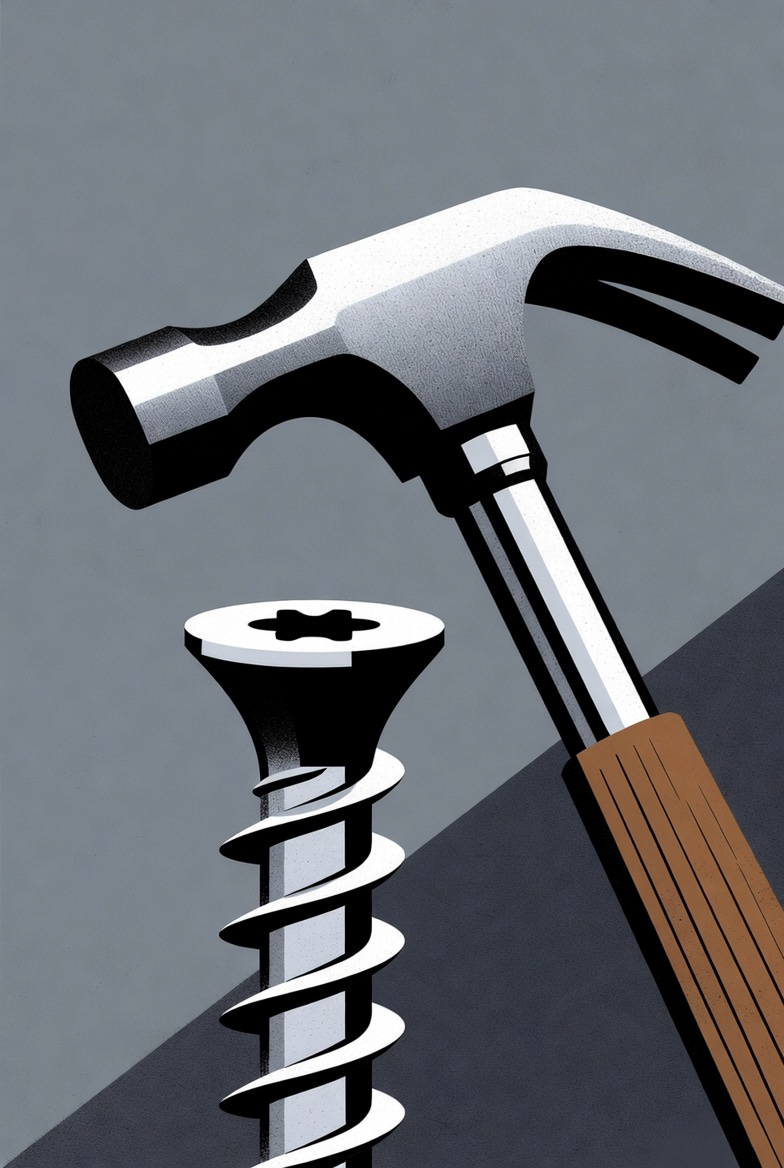
Sort of how if you really needed to, in a pinch, you could hammer a screw into some drywall. That’s not what the hammer’s for, the screw isn’t going to sit properly, and you’ll feel a little silly while you’re doing it; but where there’s a will…In this way, things like clinical trials, political polling, and advertising can make some modest claim to legitimacy as (imperfect) sciences.
And there’s the trouble: authority by association.
When we put chart reviews under the same heading as particle accelerators – Science! – it oversells our capacity to delineate, quantify, and safely manipulate human beings. Worse, it subtly encourages us to treat human beings as just another category of stuff to be studied.
To be clear, I don’t mean some academics are tricking the lay public into an outsized sense of awe and wonder. By and large, we’ve fooled ourselves! At least in polite society, the cultural underpinnings of Western civilization have been all but replaced by the quasi-religion of Scientism: this odd notion that science and scientific evidence are the only good means of knowing things.
After all, who needs screwdrivers when you’ve got the biggest, baddest hammer of all time?
I suppose this is to be expected. Our growing command and comprehension of the physical world these past centuries has, with a simple kind of logic, driven a rise in philosophical materialism (we’re all just atoms or waves or something, after all). But perhaps more troubling, those technical wonders we conjure from various hydrocarbons have instantiated an overblown sense of the power of Science, writ large, at the same time that more and more schools of thought – some of which barely qualify as philosophy – are now considered “sciences.”
This, ironically, has led many card-carrying adherents of Scientism to conclude that any old thing printed in any old Peer-Reviewed Journal is automatically Data. And Data, of course, are to be Believed – to the exclusion of all else: data about particles; data about populations; data about persons…it’s all ScienceTM, after all! And if it’s not published, it’s not proven!
Now, should a reasonable person only believe things supported by published Data?
Well, no. First and simplest, Science is utterly unconcerned with the vast majority of facts we encounter and believe every day. What did you have for breakfast? Which brand of mustard do you prefer? What color socks did you wear last Thursday? These questions are as trivial as they are hyper-specific and irreproducible, which makes them unanswerable by the scientific method, sure, but also not worth the effort – like taking a hammer to a thumbtack.
But there are some questions that are answerable with scientific or semi-scientific methods, and yet have never appeared in our journals. For starters, what are the odds that the question is even asked? Time and funding are finite resources, after all, and there are many sacred cows untouched by researchers with bills to pay and families to support. Further, even if the question is asked, will the answer see the light of day? Most vaunted publications have not quite caught up to the Internet Age: the file drawer effect is real; positivity bias is real; ideological capture is real. And yet, how often are we asked to discount the evidence of our own eyes, simply because no one has published a paper that prints the things we see?
Remember this the next time someone rejects a reasonable idea, simply because “there’s no Data to support that!”
Now, should a reasonable person believe all things supported by published Data?
This is a thornier question, but not for the obvious reasons. To be fair, the True Scientist would immediately tell you that studies can always fail to replicate, conclusions can be overturned, new data can come to light, and so on. These are all very valid concerns, that function even within the framework of Scientism.
Beyond this, however, consider our prior concerns about how many findings get excluded from publication; this alone suggests that some published studies lack necessary context, even if they are internally valid. And of course, the effect of ideological capture and various biases in the publication process are just as relevant when considering what does make it onto the journal pages.
Remember this the next time someone suggests an unreasonable idea, simply because “there’s Data to support this!”
Where does this leave us? We have those material and mechanical questions perfectly suited for the Scientific MethodTM, and these pesky puzzles about people that we try to answer somewhat ScientificallyTM. Setting those aside, and at the risk of committing the greatest heresy against Scientism, I would finally suggest a set of utterly un-ScientificTM questions:
Why, should, ought, can, and other pesky words for motivation and meaning.
These are famously impossible to measure, and are thus poor subjects for experimentation. From this, some conclude that meaning, as such, doesn’t exist (despite, of course, their and everyone’s constant lifelong experience of it). Others accept some sort of squishy, subjective, personal values, but treat these as equivalent to one’s preferences in food or music.
The great irony, of course, is that these immaterial matters are what matter most, to most people, most of the time. Which is why ObjectiveTM RationalTM ScientificTM types even today are still trying to escape Hume’s guillotine and calculate their way back to normal, traditional ideas of meaning and morality that we all already share.
Similarly, this brings us circuitously back to the first and main question at hand:
What do you know, and what do you just believe?
The mentality of Scientism we’ve explored here is distressingly common today: “those things we know scientifically, with measurement and data and studies, are the only things we truly know; all else is mere belief!”
Friends, I spent many years wallowing in just that sort of perpetual skepticism, and I would not recommend it as a wholesome or satisfying way to live.
But you tell me, have you ever found fulfillment in a statistic?
In everyday life, do you really think we’re all some Homo economicus, traversing life one rational calculation at a time, adapting and adjusting through unconscious models of Bayesian inference? Or do we just trust our friends, common sense, and tradition?
At work, how many people have you met who actually meet inclusion criteria for the trial you’re relying on to tell you what to do? How many of them can or will adhere to the protocol from that trial? How many have comorbidities or addictions or bills or any number of other idiosyncratic factors that at least nudge your decision-making away from calculation, and toward something like an informed but intuitive art?
So perhaps we can set aside all the throat-clearing, ass-covering, buck-passing logorrheic doubletalk we learn in our corporatized academies, and learn again to speak with plain authority. Perhaps we can re-discover that we are the ones with the authority, after all – and we do know very many things. Perhaps we can again find strength in conviction.
While some questions really do need scientific answers, so many problems we face in medicine need an approach that is, if anything, Scientif-ish. People are screwy, after all! Depending on hard Data will inevitably leave you in paralysis or self-delusion.
Instead, I would challenge you to embrace uncertainty, even so far as to Believe things you don’t really Know. Until eventually, with time and patience, you realize how much you really do Know – Data be damned!
The alternative is, forever and always, hammering a screw.